

This article is a part of your HHCN+ Membership
One of my favorite parts of being HHCN’s associate editor is guiding our HHCN+ content – the stories and resources that our team invests the most time in and that feature some of the most expert voices in the home-based care industry.
In this week’s HHCN+ Update, I’ll review the top stories and takeaways from HHCN+ content from 2025. As I reviewed the year – including our articles, TALKS interview series, and our live events – a few key themes emerged. In particular, it’s clear that our HHCN+ community is intensely focused on two key areas, which I’ll explore further in this Update:
- An evolving payment landscape, colored by the rise of Medicare Advantage and the need for reimbursement innovation
- Technology that could increase efficiency and transform operations
Our coverage of these topics and others was informed by input and opinions from HHCN+ members, and in this Update, I’ll provide more details on how we shape our coverage.
Looking to 2026, HHCN+ will continue to highlight the must-know topics, the highly requested angles and diamond-in-the-rough stories, taking cues from our members. Thank you for a great year and best wishes to all of you as we embark on 2026.
Talking payment innovation
HHCN+ TALKS is our quarterly live interview series. Members get up-close access to industry experts and pioneers to learn how to evolve and future-proof their business. If you’ve never tuned in live to a TALKS, I highly recommend doing so – and submitting questions for our guests!
In this Update, I’ll highlight two of my favorite moments from 2025’s TALKS episodes..
The evolution to value-based care is one of the most-requested topics HHCN covers. Providers struggling with slim margins see episode-based and upside-risk arrangements as a path to expand revenue while focusing on care quality.
This topic came up in the first HHCN+ TALKS episode of the year, with WellBe Senior Medical CEO Jeff Kang, who previously served as the chief medical officer of the Centers for Medicare & Medicaid Services (CMS). Kang credited value-based models as the pathway for primary care to re-enter patients’ homes.
“The big difference is the introduction of a value-based model,” Kang said. “We are not actually dependent on fee-for-service billing. We are, essentially, both the provider and the payer. We’re economically responsible for the hospital bills, the radiology bills, the specialist bills. That’s a value-based model or a full risk model. We can make it work because we’re prepared to spend the time with the patient and keep them healthy and out of the hospital. We make money by keeping people healthy and out of the hospital. It’s completely flipped. In the fee-for-service world, you make money by just seeing as many patients as you can a day, but that’s not necessarily good for the patient.”
Kang also suggested the first step home health providers can take to engage in value-based care: a shared savings model.
This segues into my next favorite HHCN+ TALKS takeaway, also regarding payment innovation: the reimbursement flywheel. This concept is rooted in upside performance dollars tied to Medicare Advantage and was outlined by Sue Chapman Moss, managing director of payer and provider contracting and strategy at Bayada Home Health Care, during our Q3 TALKS episode.
For Bayada, a shared savings model allows the company to reinvest in workforce, technology and clinical innovation, Moss said.
“The payment model with Medicare Advantage allows us to be able to distribute upside performance dollars back through our organization to continue to invest in the data pipelines, the talent, the people to be able to deliver the results that we’re really proud of,” Moss said. “That’s the impact it’s had on margins. I think what’s really interesting about my tenure here at Bayada is that I can’t imagine what sort of margin pressure we would be facing without having done this body of work.”
In my view, creating this type of flywheel is of the utmost importance for providers, who have told HHCN that they recognize the need for innovation but regularly encounter barriers such as cost and training needs. One type of innovation on the reimbursement side can fuel providers’ innovation in other crucial areas of their businesses.
Shaping HHCN+ stories
I’d like to lift the hood a bit on how our team orchestrates HHCN+ content.
Many of our stories come from a quick aside from a source during an interview or a hallway conversation at an in-person event.
But the general scope of our coverage is guided in no small part by direct input from our HHCN+ members, and not just the ones we can catch up with over a video chat or at a networking reception. HHCN conducts an annual survey of our HHCN+ members, and its findings guide the topics we prioritize above others. There is always time for an oddball story that comes from the depths of my notes app, of course, but this survey helps our team determine the questions we ask in interviews, the stories we publish soonest, the topics we discuss during HHCN+ TALKS episodes and even the content of some of our panels at live events.
For instance, respondents said that they were most interested in learning more about AI and electronic medical records when it comes to discussing technology. In 2025, we covered a range of AI-related topics, including how AI tools help alleviate pressure from the Outcome and Assessment Information Set (OASIS) and the policies providers have implemented to safely leverage AI without creating compliance risks. These survey insights also guided me to write two stories on EHRs: one on selecting the right EHR, and another on integrating and maintaining that EHR.
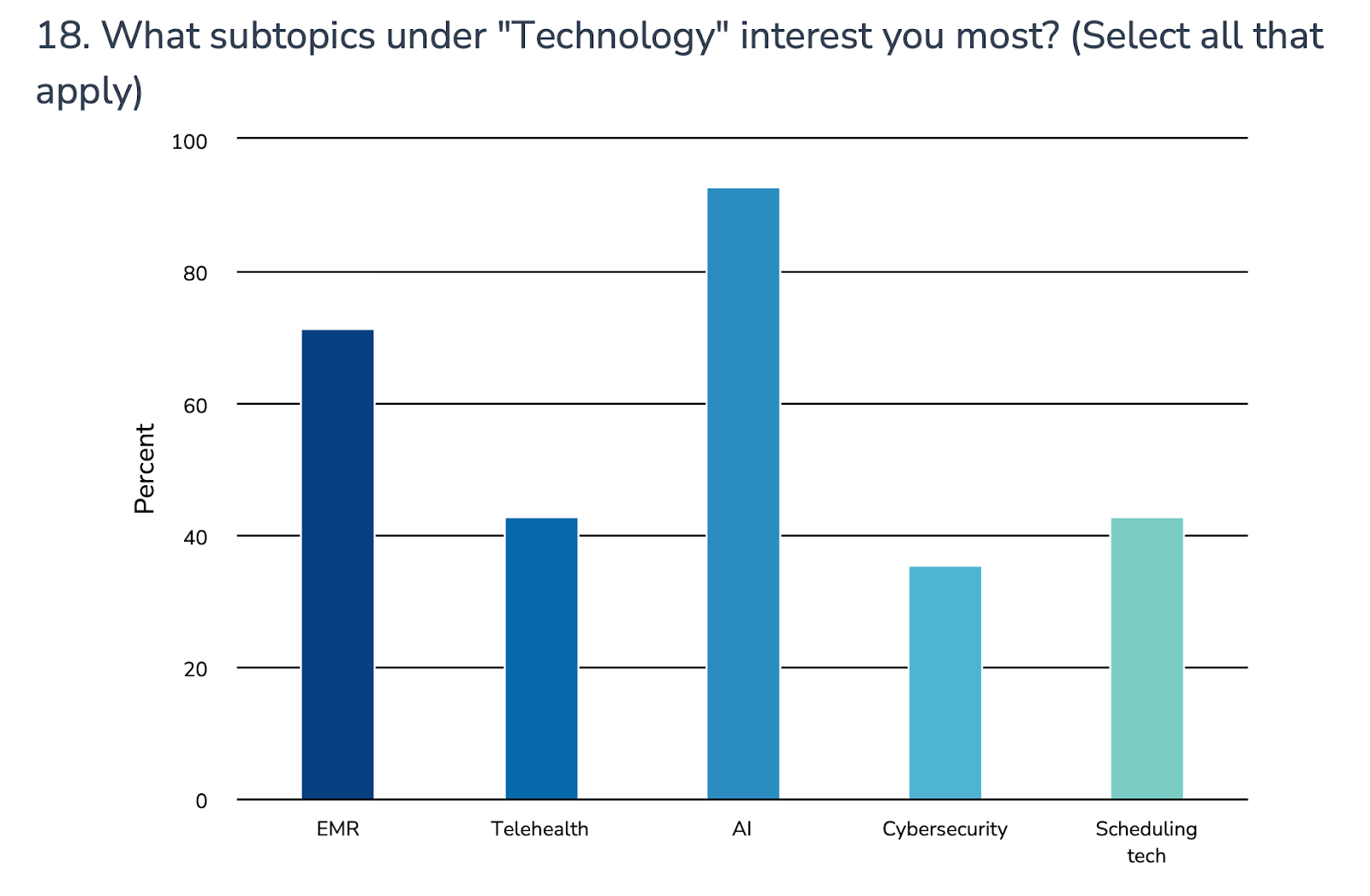
Here are a few of the key ideas from our coverage of AI and EHR technology:
AI and tech adoption are shaping strategic readiness for broader regulatory and payment shifts: Providers are not only using AI to reduce documentation time but view AI as a strategic tool to navigate value-based care and increased reporting expectations. AI-related insights can be used to analyze trends and outcomes that help agencies prepare for payment model shifts, including risk-based contracts and quality reporting demands.
Technology choices (AI and EHR) are forcing providers to rethink workflows and upgrade infrastructure: Selecting and integrating an EHR isn’t just about technology — it reveals deeper organizational needs, such as change management, cross-functional collaboration and data governance. Home health leaders report that EHR implementation often surfaces gaps in internal processes and highlights opportunities for workflow redesign, training and greater data interoperability.
AI is highlighting data quality and interoperability limitations: Using AI to assist with documentation aids efficiency, but brings into focus any problems with underlying data in EHRs and other systems. To get meaningful outputs from AI, agencies must have clean, standardized data flows and better integration across platforms and clinical and operational functions. This is influencing EHR configuration, data governance and interoperability practices.
Additionally, I said earlier in this Update that we regularly hear requests for stories and content about value-based care. This isn’t anecdotal. The HHCN+ survey found that 80% of respondents interested in learning more about Medicare and Medicaid policy want to narrow in on value-based care models (beat out only by desire for more focus on Medicare Advantage, which we discussed at length in several TALKS episodes and stories this year).
One respondent specifically asked for “more focus on transition to value rather than [fee-for-service]. The more information on this the better.” Another asked us to “push for the true definition and measurement of [value-based care] that the industry can rally around and build a functional model. Single point of truth needed for success.”
Comments like this one strike at difficult but important questions that do not have simple answers. It’s clear that a “true” definition of value-based care, particularly in non-Medicare home care, continues to evade the industry.
“That is the next hill that we have to climb, is if we as an industry can help define what value-based can be in personal care and show them a path of what that will be,” Kunu Kaushal, CEO of Senior Solutions, said at HHCN’s FUTURE conference this year.
The home health definition is a bit more straightforward, but still complex. Check out my podcast episode with Mike Johnson, chief researcher of home care innovation at Bayada, for his thoughts on the matter if you missed it.
Looking back at this survey and the coverage that it inspired, I can’t help but feel excited about the stories and content that HHCN will cover in 2026. Sure, there will be more conversations about payment, technology and operations, but we’ll continue to uncover the niche topics and exciting home-based care initiatives that might otherwise go undiscussed. I’ll continue to reflect on our members’ input at every step along the way.
The post Payment Landscape, Technology Changes Made 2025 Dynamic Year In At-Home Care appeared first on Home Health Care News.