
This article is a part of your HHCN+ Membership
Just a few years ago, home-based care dealmaking was defined by speed and scale. Today, that playbook is being rewritten.
At this year’s Capital+Strategy event, one theme came through clearly: buyers are more disciplined, more selective and far more focused on what actually drives value. Higher interest rates, shifting reimbursement dynamics, advancing technology and persistent workforce challenges have forced acquirers to evolve.
But while the metrics have changed, the fundamentals have not disappeared. If anything, the industry’s new level of scrutiny is elevating the importance of factors that are harder to measure. Across conversations at the event, leaders repeatedly returned to culture as a deciding factor in whether a deal ultimately succeeds or fails.
Even as buyers’ expectations for crucial data like billable hours, client or patient growth and retention increase, the “softer” elements of a business are carrying more weight, not less.
In this exclusive, members-only HHCN+ Update, I’ll describe the updated home-based care dealmaking outlook and share my key takeaways from Capital+Strategy, including:
– The new realities of valuations and dealmaking
– Why “soft” elements of a business matter just as much as numbers on a page
Dealmaking shifts
Just a few years ago, scale and speed were often enough to drive a deal. Today, buyers are far more skeptical and far more focused on what actually drives a business’ value.
“There’s a lot more focus on billable hours, true growth stories, workforce retention, and overall caregiver KPIs,” Jen Lentz at CEO, Avid Health at Home, said. “It’s changed the conversation about valuation, and I think there’s a little bit more of a broader stroke on how you can really value a business.”
A shifting reimbursement landscape has also colored the way buyers approach a deal. Mike Trigilio, the CEO of HouseWorks, said state-level Medicaid changes have changed, which states the company finds attractive to move into. He also specified that a deeper understanding of compliance risks in these states is now essential.
Valuations have certainly shifted from their high heights just a few years prior – though sellers’ expectations may not have shifted as much.
“There’s still a gap between what a seller expects and what they may end up getting at the table, and some of that does come from brokers who are advising them [at that] 2021, 2022 evaluation,” Lentz said.
In the current market, Lentz said that – generally speaking – single shop, single payer, single state providers are likely in the valuation ranges of 3x to 5x. To get to the “sweet spot” of 7x to 10x, companies have to be exciting and boast significant strategic value. One example of this strategic value is a diversified payer mix, Lentz said.
Another clear transformation in home-based care dealmaking is the role of AI.
“People are asking questions that we wouldn’t have even understood what the words meant five years ago, like what’s your AI tech stack?” David Bell, the founder and CEO of Grandcare Health, said. “But it’s just as fundamental a question as what your EMR was.”
It’s not just about whether a company has AI tools or which ones they employ. It also comes down to how the company thinks about AI, according to Lentz. Companies that use AI differently from how Avid uses it get Lentz “fired up.”
Providers’ takes on dealmaking shared at Capital+Strategy align with broader dealmaking descriptions by analysts. In its 2026 health industry global outlook, professional services firm PwC said that the dealmaking across the health care industry will accelerate in 2026 following two years of economic volatility and regulatory uncertainty – and that dealmaking will shift as buyers prioritize “assets that feature high-quality innovation, robust data, recurring cash flows and steady margins.” In home-based care, I read this shift to focus on innovative targets to mean providers with modernized payer mixes and strong AI enablement.
As a bit of an aside, and as evidence of the attractiveness of the home-based care industry, PwC’s outlook specified that by 2035, more than $1 trillion in global health care spending is projected to shift toward health care segments focused on prevention, personalized care, digital ecosystems – and home-based services.
The squishy stuff
As a reporter, it’s easy for me to fall into focusing on the parts of a story that are backed by data or are clear-cut, in order to craft a story with, ideally, actionable steps providers can take based on information from experts. Sometimes, talking about culture and narratives feels almost “squishy.”
At Capital+Strategy, I was largely expecting providers to discuss valuation shifts (or the lack thereof), evaluation strategies, AI enablement, and the types of deals being completed. And I got plenty of that, with operators sharing insights into how their companies executed deals in practice. What I was rather surprised about was how often providers emphasized the importance of some of the softer elements of dealmaking – connection, culture and having a clear story.
Dean Alverson, the CEO of LifeCare Home Health Family, said culture is his top concern when examining a potential acquisition target.
“The first thing I want to test for is culture, making sure cultural fit, because that’s the enemy of success,” Alverson said. “We did five acquisitions this year alone, and over $80 million, and we just passed on anybody that didn’t have a good culture.”
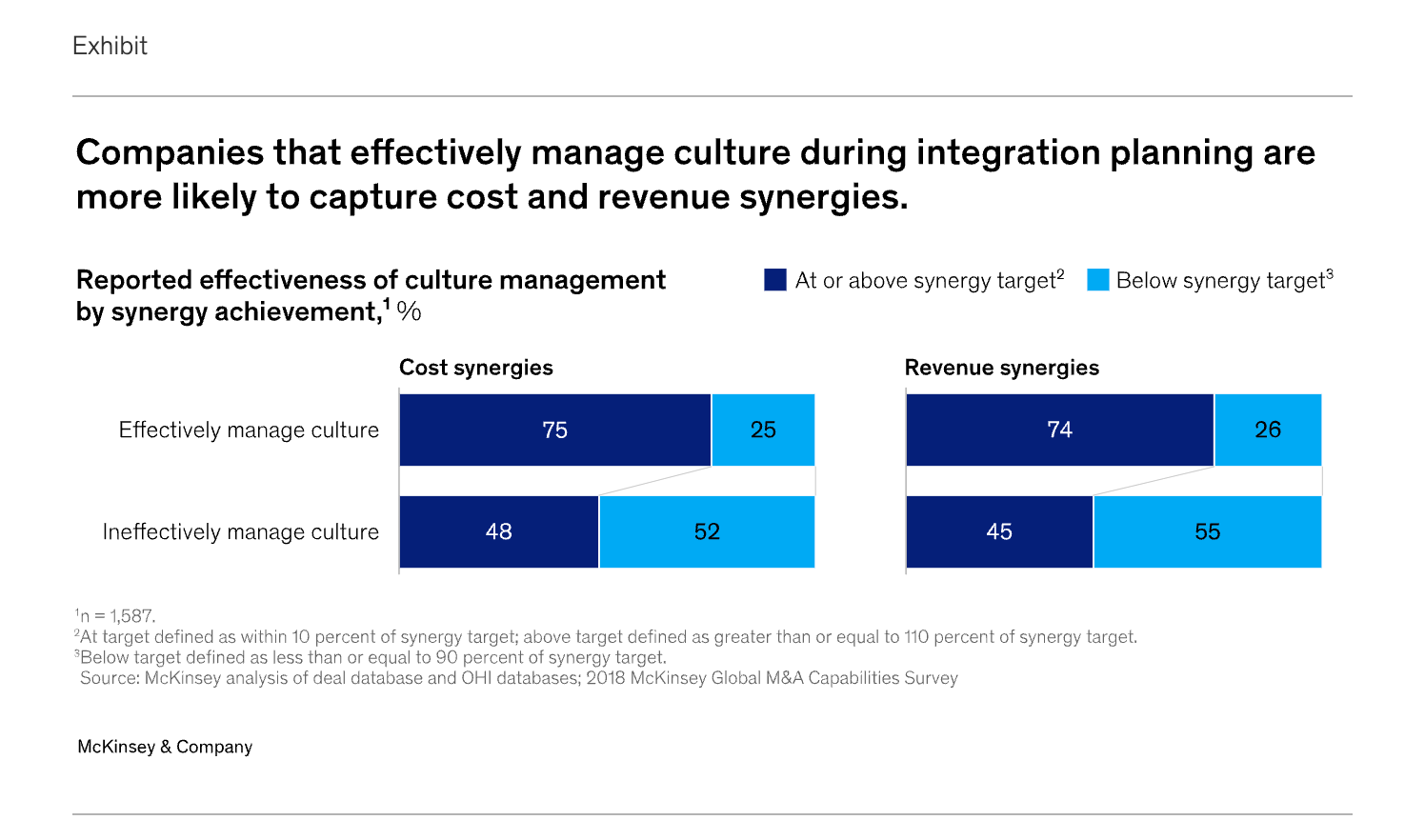
And just because these elements can seem squishy to me, it doesn’t mean that data doesn’t back up their importance. McKinsey & Company found that “companies that manage culture effectively in their integration planning are around 50% more likely to meet or exceed their synergy targets – across both cost and revenue synergies.”
I’ll briefly hit on an example shared by Mark Hunt, president of Elevate Home Health, that demonstrates the stakes of cultural fit.
In previous jobs at a large home health provider and a large hospice provider, Hunt oversaw the closure of eight agencies in Utah due to a cultural mismatch.
“Both [companies] had operations in Utah,” Hunt said. “In both of those, we had bought [agencies] from the owner operators, and five, six years later, we ended up selling them back to the owner operators for like 10 cents on the dollar. It was a cultural thing, not a religious issue. We were the interlopers coming in there trying to put our big box mentality in the pioneer state, trying to run things our way, and we completely destroyed a very good business.”
With stakes determined, I was fascinated to hear how leaders assess a company’s culture, and strategies range from data-backed to more perception-based.
Rich Tinsley, board advisor at Help at Home, also said he starts a potential deal by listening to the company’s story – specifically, listening to how leadership describes their clients and caregivers.
“Because any company that’s … not about the caregivers and the clients, I’ll pass,” Tinsley said.
Another “test” of sorts is how providers talk about the less attractive elements of their operation. Sellers have to “own up” to problems within their organizations, Cameron Cordts, corporate development manager at Purpose Care, said, and specify what they plan to do to avoid recreating the problem. Transparency is therefore part of cultural diligence.
Steven Gonzalez, the president and CEO of HealthView Home Health & Hospice, has partnered with Great Place To Work to survey companies and determine if a company is a good target for an acquisition.
A notable difference between Gonzalez’s approach and that of several other providers speaking at the event was his interest in turning a company’s culture into an attractive one if it doesn’t score highly on his culture scale.
“We feel like we have that formula to go into an environment where we could turn an organization around, which we did with HealthView,” he said. “Healthview, when we acquired it [was] completely bankrupt in both balance sheet and culture. And so in three years, we got on the Fortune list, 95th percentile for great places to work and retention is at its all-time high.”
One buyer walks away if culture isn’t there – another believes they can fix it. Regardless, having a clear impression of a potential acquisition’s culture is essential for providers to make an educated decision before making a substantial investment.
Culture may be more difficult to quantify than turnover rates and client growth records, but its consequences are not. Deals can look sound on paper and still unravel if the underlying culture isn’t aligned or understood.
What stands out to me is not just that culture matters, but that there is no single approach to handling it. Some buyers see misalignment as a dealbreaker, while others see it as an opportunity to create value through transformation. Whether a buyer chooses to walk away or lean in, the risk comes from getting its assessment wrong, or worse, from not evaluating it seriously in the first place. In a dealmaking environment where growth is harder to come by and mistakes are costly, the “squishy” elements may be the ones that ultimately determine who wins and who doesn’t.
The post Inside The New Rules Of Home-Based Care Dealmaking appeared first on Home Health Care News.