

This article is a part of your HHCN+ Membership
The turn of a new year typically sees deals forged in the prior year finally close, leading to an uptick in transaction volume. The home-based care industry certainly saw evidence of this, with a few notable deals closing out since the start of 2026.
Choice Health at Home acquired a trio of home-based care businesses, Interim Healthcare acquired its second-largest franchise and Main Post Partners acquired HomeWell Care Services. Other deals relevant to the industry also crossed the finish line, with SilverAssist acquiring Caring.com, for example.
I’m generally loath to say that one month with a few notable deals flags a definitive sign of increased activity. But new data from Pitchbook found that home-based care saw a 22.4% increase in deal flow in 2025, so there is certainly reason to think that the strong start of the year is not an outlier.
Beyond information about deal volume, Pitchbook’s new report, and an interview I had with Brian Wright, lead analyst of health care at PitchBook, included several nuggets of information that excited me.
For one, there is evidence that pediatric in-home care is of increasing interest to investors and buyers. This sub-sector comes with a slew of specific challenges, so it won’t be an easy service line expansion for providers – but it could be a promising one for providers ready to make the investments necessary for success in this market.
Secondly, dealmaking trends will be characterized by technology adoption. While on the health care services side, AI is not currently driving dealmaking, according to Wright, tech innovation will come to play an increasingly critical role in dealmaking – separating the industry into winners and losers.
In this members-only, HHCN+ Update, I’ll give my predictions for dealmaking in 2026 and provide analysis and key takeaways, including:
– Why providers must choose between care continuum and specialized care
– The risk of being a late technology adopter
– Why home-based care dealmaking will increase in 2026
Pediatric home-based care on the rise
Pediatric home care and foster services saw a notable 50% increase in deal volume in 2025. In my view, this uptick in investor interest suggests pediatric in-home care will become increasingly common – even as providers have to overcome significant hurdles to care for this population and seize this opportunity.
“Depending on the market, I think you have a tremendous opportunity to make a difference in the community,” Mark Bush, CEO of Care Options for Kids, previously said at Home Health Care News’ FUTURE conference. “But it’s such a heavy, emotional, psychosocial [load]. This is a hard business to be a sidecar to something else. I think you would likely need a dedicated team focused on private duty, because it’s 24/7. It’s very different than some other, more intermittent, home health care delivery services.”
Providers looking to capitalize on growing interest from buyers and demand from patients – and the ability to provide crucial care for young people – must carefully consider the need for a dedicated team and a narrow focus. But the investments could pay off for those who do.
I must clarify that Pitchbook did not separate pediatric home-based care from foster services in this data point, and could not immediately do so upon request. So my prediction of this trend comes with a caveat, but regardless, this data suggests that pediatric in-home care is of growing interest.
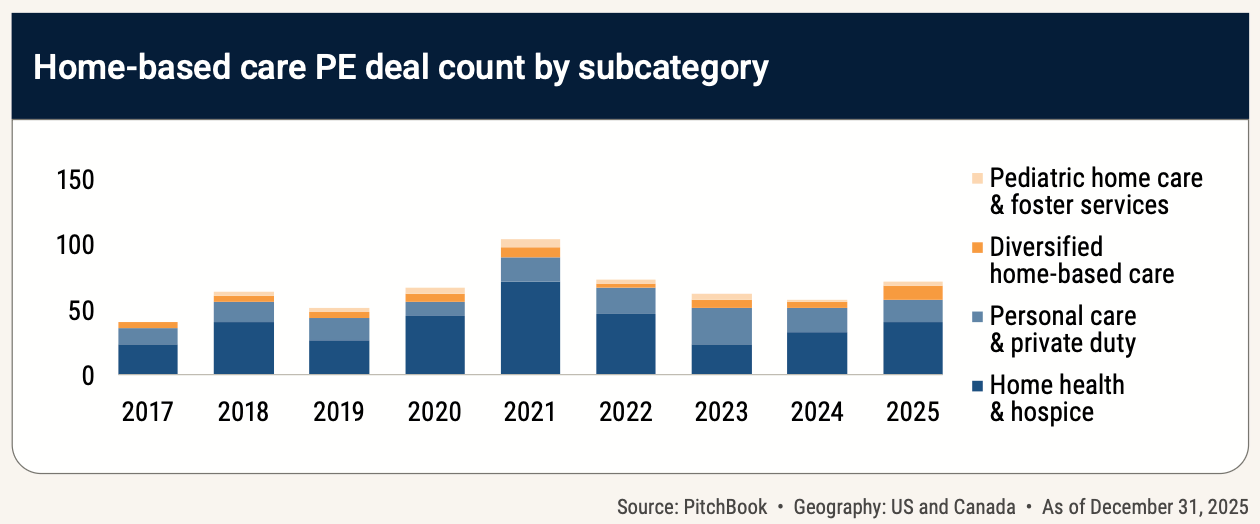
The only sub-segment of home-based care with a higher year-over-year uptick in deal volume was diversified home-based care, which saw a 120% increase. Investors are therefore most interested in providers approaching home-based care from a one-stop shop perspective – which brings me back to the recent Choice acquisitions.
Choice CEO David Jackson has told HHCN that his growth strategy is to become a comprehensive in-home care provider, and the trio of acquisitions demonstrates this. The recent Choice acquisitions span the continuum of home health, palliative and hospice care and personal home care. The 120% increase we saw in 2025 demonstrates that Jackson is not the only one leveraging this strategy.
The friction between the two subsegments of home-based care with the highest deal volume growth, of course, is that one requires generalized home-based care services and the other, hyper-specific pediatric care.
More deals will show the technology winners
There are a few factors that suggest deal volume will increase in 2026. Private equity’s inventories are aging, and the valuation gap created from sky-high valuations created during the height of the COVID-19 pandemic is set to close, Wright said.
“If you think about a couple more rate cuts in the back half this year, when we get a new Fed chairman, the cost of money gets cheaper,” Wright said. “Also, as people are implementing these new ambient scribing technologies and health care services workflow agents, they fundamentally change the return profiles for these companies going forward and enhance the profitability of the businesses. So I think that lower cost of capital and improved long-term margin profiles for these companies should narrow these gaps, and we should get more deals in 2026.”
I’m particularly interested in the technologies that enhance profitability. A slew of fresh tech is helping companies improve efficiencies, care quality and outcomes. Most often, I hear about providers instituting back-office-enhancing technologies that help with recruitment or payroll, but the excitement seems to surround ambient scribing capabilities and other AI technologies.
Many folks I talk to, while excited about these technologies, are happy to be mid-pack adopters. Cautious optimism seems to rule the day, currently. But for those who run too conservatively, there could be consequences.
“Ultimately, it’s a fundamental operational execution issue, and those that execute well are going to benefit from the technology,” Wright said. “To me, the winners and the [well] operating companies, that gap between them and everybody else is going to expand, and that’s going to create an opportunity to roll up some inferiorly run companies.”
These mid-pack adopters, if they don’t time their technology adoption plan right, stand to miss out on being the winner in this scenario. And I hate to suggest a binary between winners and losers, when what really matters is the quality of patient care and outcomes. But there is a risk that providers that stand too still in the fast-moving river of home-based care technology will be swept off their feet, while those that move with the current become what Wright predicted: the “winners” of home-based care.
The post Inside the Trends Shaping At-Home Care M&A in 2026 appeared first on Home Health Care News.